Last updated November 18, 2026
ADU Emergency Preparedness Guide for Boulder City Homes
If a fire starts in a detached ADU on your Boulder City property, your homeowner’s insurance policy may treat it as a separate structure with its own coverage limit – and if your tenant is injured because the ADU lacked a connected smoke alarm system, the liability question lands on you. That’s the part most preparedness guides skip. Add a second occupant, a second utility service, and a second structure on the same lot, and every emergency scenario doubles in complexity. This guide covers what makes ADU preparedness different: fire department access requirements, Nevada landlord obligations, utility shutoff labeling, extreme heat protocol for a desert climate, and the paperwork you need on file before something goes wrong. Everything here is written for a Boulder City homeowner protecting two structures and everyone inside them.
Quick Answer
Emergency preparedness for a Boulder City ADU means treating the second structure as a fully independent dwelling: a connected smoke and CO alarm system, clearly labeled ADU-specific utility shutoffs, a written tenant emergency plan that meets Nevada landlord notice requirements, documented fire department access, and an insurance file containing your permit records and inspection photos. The goal is that any occupant or first responder can act within 60 seconds without needing to ask you anything.
Table of Contents
- Why ADU Emergencies Are Different From Main-House Emergencies
- Fire Department Access and Gate Configuration in Boulder City
- What Nevada Landlord Law Requires for ADU Occupants
- Utility Shutoffs: Label Them So Anyone Can Act in 60 Seconds
- Extreme Heat Protocol: When HVAC Failure Becomes Life-Safety
- Insurance Documentation to File Before an Emergency
- The Two-Structure Emergency Drill
- Common Mistakes to Avoid
Why ADU Emergencies Are Different From Main-House Emergencies
A detached ADU isn’t a spare room with a door. It’s a legally separate dwelling unit with its own utilities, its own occupants, and its own coverage line on your policy. That separation creates three vulnerabilities generic home emergency guides never address.
The first is the occupancy relationship. You may live in the main house; someone else may live in the ADU. In an emergency, you’re not just protecting your own family – you’re a landlord with notification duties and habitability obligations that don’t apply to your own household.
The second is utility sub-metering. Many Boulder City ADUs run on a sub-panel fed from the main service, or on a dedicated gas line with its own shutoff. If a plumber or first responder doesn’t know where that shutoff lives, water or gas keeps flowing while everyone hunts for a valve. We’ve walked properties where the ADU water shutoff was buried behind landscaping three years after the build. Labeling is the fix, and most homeowners don’t do it.
The third is structural separation. A detached ADU’s fire alarm system has to communicate with the main house if you want early warning – or at minimum, an occupant needs a clear path out that doesn’t route them past the hazard. Distance from the main dwelling changes how a fire, a gas leak, or a medical emergency plays out. Working with an experienced ADU builder in Boulder City from the design stage is how you bake this into the structure rather than bolt it on afterward.
Fire Department Access and Gate Configuration in Boulder City
Boulder City’s low-density lots and long driveways are a real advantage for ADU placement – and a real problem if your gate or driveway layout blocks fire apparatus access. Here’s what to think through before and after a build.
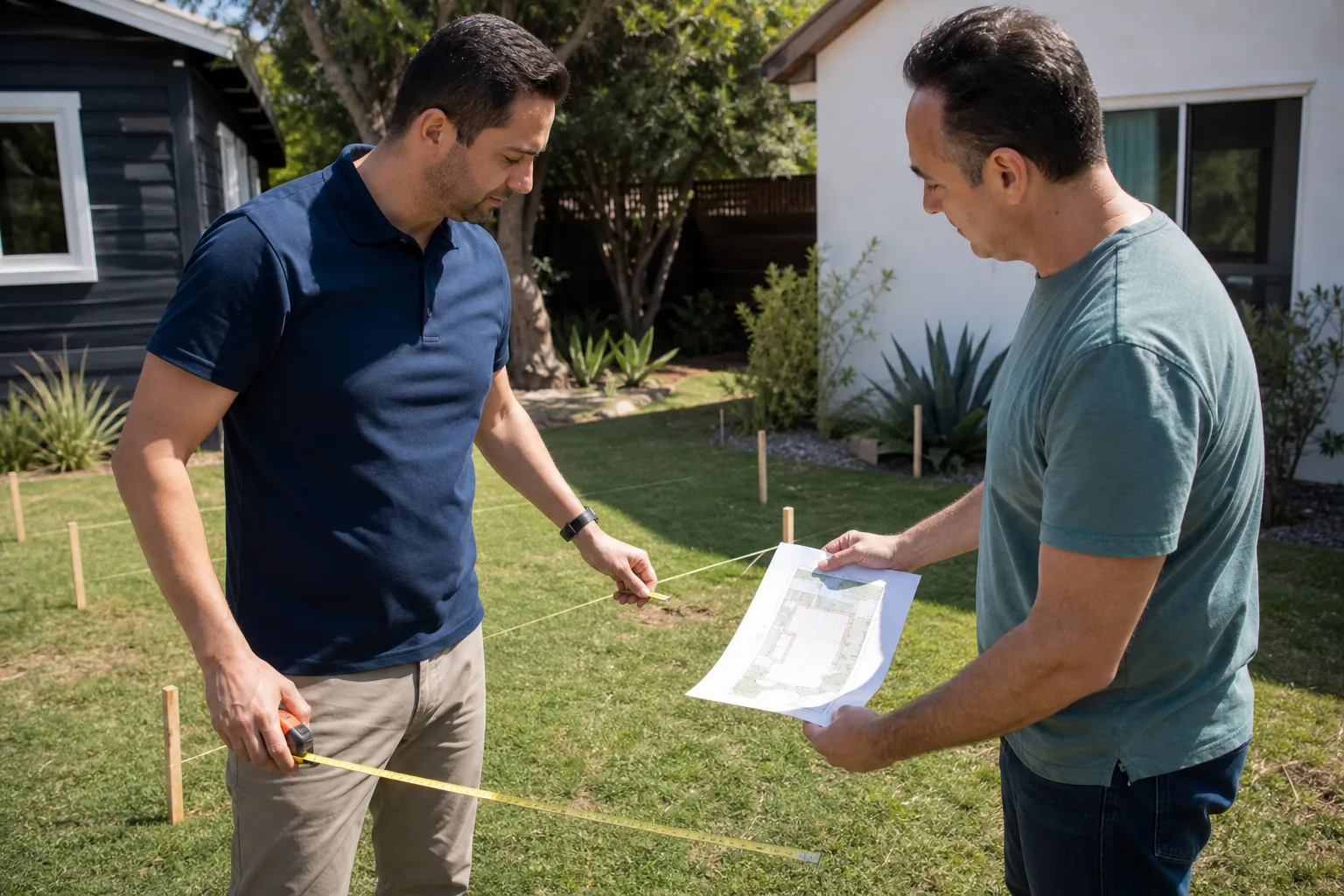
- Driveway width and turning radius. Fire apparatus needs a clear, unobstructed path from the public street to within a reasonable distance of the new structure. Narrow decorative gates, sharp turns, and low-hanging branches all break that path. If your ADU sits behind a gated courtyard, walk the entrance with a tape measure – not your landscaper’s instincts.
- Gate hardware. Any locked gate that first responders need to pass through should open by a method the department can access. The standard practice is a key box or an agreed-upon gate code registered with the fire department – never a padlock only you and your tenant know.
- Clear signage. If your ADU has its own address designation, post it visibly at the street and at the structure. Ambiguous addresses cause delays in the dark and in smoke.
- Hydrant and lane clearance. Don’t let the second structure’s landscaping, planters, or a parked vehicle close off a fire hydrant or narrow the lane.
In our experience, gate configuration gets decided for aesthetics during design and only becomes a fire-access question at inspection. Raising it with your builder and the reviewing official early saves a rebuild – and a change order. If your property is also getting a room addition or a second structure, a qualified home addition contractor in Boulder City can coordinate the access plan once across both builds instead of carving it up twice.
Numbered steps to verify fire access
- Measure the narrowest point of your driveway and any gate opening.
- Walk the path at night with a flashlight to catch low branches and dark corners.
- Confirm how a locked gate opens to a fire crew, and register access with the department if required.
- Post address numbers at the street and at the ADU entrance.
- Clear hydrants and lanes of planters, vehicles, and stored material.
- Re-check after any landscape change or new fence install.
What Nevada Landlord Law Requires for ADU Occupants
Nevada landlord law requires a landlord to maintain the rental unit in a habitable condition – working smoke alarms, safe heating and cooling, functional egress, and a clear emergency contact. That obligation applies to your ADU tenant even though the tenant lives on the same lot as you. Living on the same property does not exempt you; in fact, it raises the standard of care, because you had access to the unit and could have addressed a known problem.
What that means in practice for a Boulder City ADU:
- Smoke and CO alarms that actually work. Test monthly, replace batteries as the manufacturer prescribes, and replace units on the recommended schedule. Don’t assume the unit you installed at build time still works two years later.
- Two ways out. Every sleeping room needs a viable secondary egress – an operable window of adequate size. If your ADU design has a bedroom with only one door out, that’s a life-safety problem, not a floor-plan preference.
- A written emergency contact and notification protocol. Tenants have a right to know who to call and how they’ll be notified about a hazard affecting the property. Put it in writing.
- Entry rules apply in an emergency. You have immediate access to address an emergency, but the plan should document what “emergency” means and how you’ll communicate afterward.
The difference from main-house obligations is the notification piece. In your own house, you just act. With a tenant in the ADU, you act and inform, and you document that you did both. If your ADU was built by a team that follows written standards and keeps records, you’ll have the documentation to back that up when it matters – a good reason to choose a room addition contractor in Boulder City who hands you a written price and a real paper trail on every job.
Utility Shutoffs: Label Them So Anyone Can Act in 60 Seconds
A shutoff you can’t find in a panic isn’t a shutoff. The target: any occupant, neighbor, or first responder locates and closes the ADU’s gas, electric, and water shutoffs inside 60 seconds, in the dark, without calling you.
Here’s how to set that up:
- Map every shutoff first. Find the ADU’s water main valve, the gas shutoff specific to the ADU if it has one, and the electric sub-panel that serves the unit. Confirm what each one actually controls – a valve that feeds only the hose bib won’t help you.
- Photograph each shutoff with a label or landmark in the frame so you can identify it from memory and share it with a tenant or a plumber.
- Label with plain language and an arrow. “ADU water shutoff – turn clockwise” beats a cryptic tag. Use weatherproof labels; a Sharpie on a pipe fades.
- Post a single laminated one-page sheet inside the ADU near the door, with the location of each shutoff, the address, and the emergency contact number.
- Walk the tenant through it at move-in and annually. Hand them the paper copy.
- Add a no-cost step for first responders – mark shutoff locations on a simple exterior-facing diagram if your jurisdiction or department welcomes it.
Do this at the same time as your alarm checks. One afternoon, one checklist, and both structures get safer. Older Boulder City homes near the historic district often have gas lines and panels that predate current labeling conventions, so a fresh set of labels and photos there is especially worth the hour.
Extreme Heat Protocol: When HVAC Failure Becomes Life-Safety
Boulder City summers push well into triple digits, and a detached ADU with failed cooling becomes a life-safety problem fast – especially for older occupants or anyone with a health condition. Treat an AC failure in July as an urgent call, not a maintenance ticket.
- Check on the tenant daily during a heat wave, in person or by phone. Confirm the unit is actually cool, not just “running.”
- Know the backup plan before it’s needed. A portable cooling unit, a window AC, or a set of fans staged in storage – decide where the tenant goes if the ADU is unlivable for a night.
- Shut the windows and cover sun-facing glass during the hottest part of the day. In a well-insulated ADU, that’s worth several degrees.
- Watch the unit’s performance, not the thermostat’s promise. If the AC is short-cycling or blowing warm, the compressor may be failing – get it looked at before the worst week of the year.
- Keep the water flowing. Hydration and a cool shower are the fallback when mechanical cooling fails.
We’ve seen the pattern in Boulder City: a unit that’s fine in June and struggles in August, which is exactly when the repair backlog is longest. Get an HVAC check ahead of summer, and confirm your back-up plan before the first heat advisory. The same logic applies to winter cold snaps – a failed heater in a detached structure is just as dangerous, just less frequent here.
Insurance Documentation to File Before an Emergency
After a fire, you won’t be hunting for paperwork – so build the file now. Your homeowner’s policy likely treats a detached ADU as a separate structure with its own coverage limit, and a claim is only as strong as the records you can produce.
- Photos of everything – exterior, interior, appliances, fixtures, and serial-number plates on HVAC and water heater. A phone walkthrough video works well as a supplement.
- The permit set and final inspection records for the ADU. These prove the structure was built to code and legally, which matters enormously when a claim is assessed.
- Receipts for upgrades – windows, insulation, the AC unit, anything that raises the replacement cost.
- Your policy declarations page, with the ADU listed and the separate-structure limit visible.
- The tenant emergency plan and move-in checklist – dated, signed, and stored with the rest.
Store the whole file in the cloud and keep one paper copy in a fireproof safe or off-site. If you’d rather build this correctly from day one, a builder that delivers a written price and documented standards – people like an Sutton ADU Builders Boulder City home team, or a dedicated ADU builder, gives you the paper trail before there’s ever a claim to make. It’s the difference between a smooth claim and a fight.
The Two-Structure Emergency Drill
A plan nobody has practiced isn’t a plan. Run a 20-minute drill twice a year – spring before the heat, fall before winter – covering both structures.
- Assign a role to each occupant: who calls 911, who meets the crew at the gate.
- Walk the escape route from each structure to the meeting point.
- Confirm both the ADU and main house smoke alarms sound and are heard.
- Have the tenant locate and describe the ADU shutoffs out loud.
- Check the gate opens and the address numbers are visible.
- Update the posted one-page sheet and log the date.
If you designed the ADU with a product line such as Abodu or Cover, the drill is still yours – the maker’s warranty doesn’t run your protocols. What makes the difference is a structure that was designed with emergency use in mind, not just livability. West-facing ADUs near Hemenway Valley and other Boulder City neighborhoods should also get a check on fire-resistant access routes and landscaping clearances as part of the same walk.
Common Mistakes to Avoid
- Assuming the ADU is covered by the main house’s policy. Detached structures often carry a separate coverage limit – confirm your declarations page lists the ADU and the limit is right for replacement cost.
- No labeled shutoffs. Unlabeled gas, water, and electric valves cost critical minutes in a real emergency. Label them the week the unit is finished.
- Smoke alarms that don’t communicate. An alarm the tenant can’t hear or the main house can’t hear is only half a system. Connect them or add alerts.
- A locked gate only you can open. Fire access through a padlock nobody else has the key to defeats the whole access plan.
- No written tenant emergency plan. Nevada habitability obligations include working protections and a clear contact – keep it documented.
- Putting off the HVAC check until August. In Boulder City, the cooling system is life-safety equipment. Inspect it before the heat, not during it.
- Skipping the permit and final inspection paperwork. Missing records turn a valid claim into a dispute. Keep the full file.
When to Call a Professional
Call a professional when a hazard is structure-related, not routine maintenance: a failed sub-panel or breaker feeding the ADU, a gas smell near the unit, an AC that won’t cool in the heat, a roof leak over living space, or any question about whether your ADU’s egress, alarms, and access meet code. If you’re adding, converting, or modifying a second structure and want the emergency plan baked in from the start, get real numbers before you commit – Sutton ADU Builders Boulder City offers free estimates in Boulder City. Call (888) 296-0055 and we’ll walk your lot, review what you have, and give you a written price before any work begins.
Frequently Asked Questions

They don’t have to be connected by law in every case, but we strongly recommend interconnected alarm systems so the main house is alerted as soon as the ADU unit sounds. If full interconnection isn’t practical, add a remote alarm or a smart-monitored system that notifies you. Call (888) 296-0055 for a free assessment of your setup.
A detached ADU is usually covered as a separate structure under your homeowner’s policy, but often with its own coverage limit that may not match replacement cost. Read your declarations page and confirm the ADU is listed. If you’re planning a build, we can help you document the structure properly for your insurer – call (888) 296-0055 for a free estimate.
Nevada landlord law requires a habitable unit – working smoke and CO alarms, functional heating and cooling, viable egress, and a clear emergency contact – and you must address known hazards promptly. Put the emergency contact and notification protocol in writing. Call (888) 296-0055 if you want to verify your ADU is set up to those standards.
A typical set of upgrades – interconnected smoke and CO alarms, labeled shutoffs, a written tenant plan, and a pre-summer HVAC inspection – usually runs a few hundred to a few thousand dollars depending on the alarm system and any HVAC repair. That’s a fraction of the cost of a claim or a liability dispute. Call (888) 296-0055 for a free, written estimate on your specific unit.
Treat it as urgent: move the tenant to a cool space, check on them daily, and get an HVAC technician out as soon as possible. Stage a backup cooling plan and call a professional rather than waiting for the backlog to clear. Call (888) 296-0055 for help assessing the repair and replacement options.
Often yes – but only if the gate opens to first responders, the driveway is wide enough, and the address is clearly posted. Confirm the access method with the department before you assume it’s fine. Call (888) 296-0055 and we’ll review your access plan as part of a free estimate.
The Bottom Line
An ADU is a second home, and it deserves a second emergency plan. The essentials: interconnected alarms, labeled and photographed shutoffs posted inside the unit, a written tenant protocol that meets Nevada habitability rules, documented fire department access through any gate, an HVAC strategy for Boulder City heat, and an insurance file with permits, inspections, and photos in the cloud. Run a two-structure drill twice a year. None of this is expensive. All of it works better when it’s built into the design rather than added after a scare. Protect both structures and both occupants – and put the plan on paper – before you need it.
Written by the team at Sutton ADU Builders Boulder City.