Last updated November 18, 2026
ADU Builders Troubleshooting: Common Problems and How to Fix Them
Most ADU horror stories don’t start with a bad foundation pour. They start with an unpermitted electrical subpanel or a final inspection that fails on a technicality nobody flagged. That finished unit sitting in your backyard isn’t a rentable ADU – it’s an expensive shed with a bathroom until the paperwork and the utilities clear. In Boulder City, where the historic district’s narrow lots and older service connections add their own wrinkles, these failures follow a pattern. This guide maps the failure points we see most often, explains who’s responsible at each stage, and gives you the exact language and steps to protect yourself before the first invoice lands.
Quick Answer
ADU problems cluster in three places: utility connections that were undersized or never fully coordinated, zoning and code compliance that surfaces at final inspection, and punchlist disputes where a builder declares the job done while items remain open. The fix is almost always documentation and contract language set before construction starts. In Boulder City, confirm your electric panel capacity, sewer capacity, and setback compliance in writing before you sign – and never accept a verbal “we’ll handle it.”
Table of Contents
- Why Do ADUs Fail Final Inspection in Nevada?
- Utility Connection Problems That Show Up After Construction
- What to Do When Your Builder Says the Job Is Done (But It Isn’t)
- What “Rental Ready” Actually Means in Boulder City
- How to Document an ADU Build So Your Warranty Means Something
- Zoning and Setback Problems That Derail Projects Late
- When the Problem Is the Product: Prefab and Modular ADU Failures
Why Do ADUs Fail Final Inspection in Nevada?
Final inspection failures on ADUs usually trace back to electrical and life-safety items, not structural ones. The structure either passes or it doesn’t – and it’s inspected early. What waits until the end are the systems, and those are where Boulder City projects trip.
Here’s the pattern we see. Panel capacity is calculated at the start, then a heat pump, an induction range, and a tankless water heater get added along the way, and the service is now undersized. Or the subpanel feeding the ADU is installed before the load calculation is finalized, and the inspector flags it. Smoke and carbon monoxide alarms get mounted in the wrong locations or wired to the wrong circuit. Egress windows in sleeping rooms are sized to the old standard. And that’s before anyone checks that the as-built drawings match what’s actually on the slab.
How to confirm your builder has addressed these before inspection day:
- Ask for the approved electrical load calculation in writing, and confirm the panel and service size match it after any change orders.
- Request the alarm layout – location and power source – signed off before rough-in.
- Confirm every sleeping room’s egress window meets current size and sill-height requirements.
- Walk the as-built drawings against the framing before drywall closes, so corrections are cheap.
- Ask your builder to schedule a pre-final walkthrough with the inspector or a third-party reviewer if your jurisdiction allows it.
When you work with a vetted ADU builder in Boulder City, ask specifically how they handle utility coordination at final. A contractor who can’t describe their process for a load calculation is a contractor who’s been surprised before.
Utility Connection Problems That Show Up After Construction
Utilities are the single most common post-construction surprise on an ADU, and the least fun, because the fix often means digging or trenching after your landscaping is done. Electrical, water, and sewer each carry their own failure modes.
Undersized electrical service. A detached ADU with its own panel is great until the load added to your main service pushes it over capacity. If your home predates the ADU, the service may have been fine before and isn’t now. Ask for the total connected load and confirm your service size in amps.
Water pressure and volume. A long run to the back of the lot can mean the ADU shower dribbles while the front house is fine. Low pressure usually comes from undersized pipe diameter, too much friction loss over distance, or a shared meter with high demand. Sometimes a pressure-reducing valve or a small booster solves it. Sometimes the lateral needs to be redone.
Sewer capacity and slope. Gravity sewer needs enough fall per foot. On a long run, the installer may need to re-pitch the line or add a grinder pump – and a pump adds ongoing maintenance. In older Boulder City neighborhoods, sewer laterals can be shared or undersized, and the planning details are set by the city before a shovel goes in.
Who’s responsible? Usually whoever was contractually obligated to coordinate with the utility. If your contract is silent, you are. That’s the whole point of putting it in writing.
What to Do When Your Builder Says the Job Is Done (But It Isn’t)
A punchlist is a written list of incomplete or defective items found during the final walkthrough. A builder declaring a project done with punchlist items still open is one of the most common ADU disputes, and the only way to resolve it is with evidence and a paper trail.
Here’s the language that works, and the steps that follow it:
- Send it in writing. Email a dated punchlist with photos of each item and a specific description (“kitchen GFCI outlet dead – tested 3/14,” not “electrical issue”).
- Set a response window. Ask for a written completion schedule within five business days.
- Refuse final payment until items close. Final payment should be tied to punchlist completion in your contract. If it isn’t, that’s a red flag you can still raise now.
- Document the delay. Keep a simple log of every item, the date raised, the date promised, and the date completed. This log becomes your warranty evidence.
- Escalate to the guarantee. If your contract includes a written workmanship guarantee, invoke it in writing. If the builder won’t honor it, ask the manufacturer or warranty provider for their dispute process.
The cleanest way to avoid this entirely is to work with a builder who gives you a written schedule and a warranty document up front. Our own Threshold Standard puts the written price and the workmanship promise on paper before a tool is lifted, which means “done” is a defined state, not an opinion.
What “Rental Ready” Actually Means in Boulder City
Passing final inspection and being legally rentable are two different things. A unit can pass inspection and still fail to be a lawful rental because of zoning, permitting, or a missing certificate of occupancy.
Rental-ready in Boulder City means:
- A valid certificate of occupancy for the unit – not just a passed final inspection.
- Zoning confirmation that the ADU is a permitted use on your lot and the address can be legally rented, particularly in the historic district where rules differ block by block.
- Kitchen and bath fully operational – hot water, a working range or cooktop with adequate ventilation, and functioning fixtures. Inspectors assume these are present; renters don’t pay for a unit without them.
- Heating and cooling that actually work in both seasons. Boulder City summers routinely cross 100°F and winters can dip toward freezing, so a system sized for a mild climate underperforms here.
- Solar or address requirements specific to Boulder City that affect the parcel and signage, which can affect your ability to rent.
Ask your builder for the certificate of occupancy in hand before you advertise. If your contract didn’t promise it, ask for it anyway, in writing. If you’re adding a room instead of a unit, the compliance picture is different – our room addition contractor in Boulder City guide covers what applies there.
How to Document an ADU Build So Your Warranty Means Something
A warranty is only as good as the evidence behind it. If a crack appears in month seven and you can’t show when it appeared or what was behind the wall, the claim gets weaker. Build your file from day one.
What to keep, and why:
- Signed contract and every change order – the dated paper trail is the foundation of any warranty claim.
- Approved plans and permit numbers – a copy of the stamped set plus the permit card.
- Pre-drywall photos – photograph framing, plumbing, and electrical before drywall closes. These are the single most useful record if a leak or wiring issue appears later.
- Inspection reports – every signed inspection from foundation through final.
- A dated maintenance and defect log – date, description, photos, and who you spoke with.
Keep everything digital and shared. If your builder sends consent to the file, even better. A 365-day workmanship promise covers defects in construction for a full calendar year from completion; to use it, you need to be able to show the date the work finished and what happened after. Documentation is what turns a promise from a sentence into an enforceable thing.
If you want to understand how this fits the broader addition picture, our guide to choosing a home addition contractor in Boulder City covers contract language and vetting standards in more depth.
Zoning and Setback Problems That Derail Projects Late
A setback is the required gap between your new structure and the property line. Setback and lot-coverage problems are the classic late-stage ADU failure, because they’re discovered when a survey or an inspector compares the as-built to the plan. By then the slab is poured.
Boulder City has a mix of older parcels, wide lots, and historic-district properties where the rules are more specific. Narrow or irregular lots in and around the historic district and older residential blocks are the ones most likely to hit a setback snag. The fix is not to argue with the inspector – it’s to confirm the setbacks in writing before design, using the actual zoning designation, and to get a current survey rather than trusting an online map.
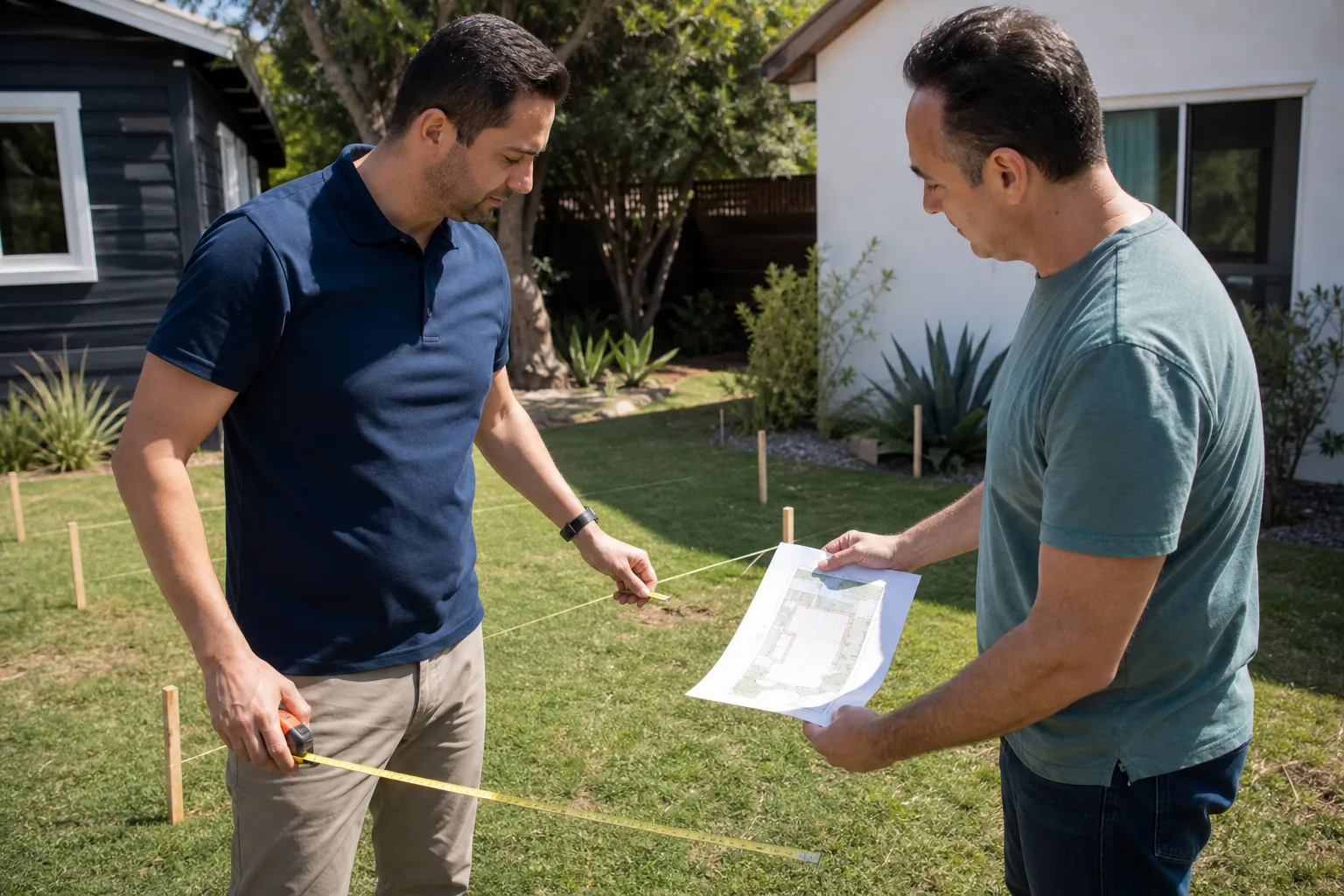
What to confirm before you sign anything:
- The zoning designation for your parcel, in writing from the city.
- The required front, side, and rear setbacks for an ADU on your lot.
- Maximum lot coverage and the ADU size limit.
- Historic-district or design-review requirements, if your property is in or near one.
- Whether the ADU can be a separate address and whether any height or parking rule applies.
A builder who quotes a price before confirming these is quoting against a guess. Get the numbers first. Confirm them in writing. Then sign.
When the Problem Is the Product: Prefab and Modular ADU Failures
Prefab and modular ADUs are a genuinely good fit for a lot of Boulder City properties – they’re predictable on cost, fast on site, and the factory settings control quality. But prefab shifts where problems show up. The house arrives built; the site work around it is where things go wrong.
Common prefab ADU problems:
- Site utilities not completed when the unit is set. The box is done, the connection isn’t, and the unit sits unlivable for weeks.
- Foundation and seismic tie-ins that don’t match the unit’s required anchoring – a manufacturer-specific detail the site contractor must follow.
- Crane and delivery access issues on tight lots, which can add significant cost if a crane can’t reach the site.
- Brand-specific warranty splits – the manufacturer covers the box, the site contractor covers the connection. If neither is clearly accountable, you’re the one chasing it.
We work regularly with Abodu, Cover, Dvele, and Mighty Buildings units and know how their site requirements differ, which matters when you’re trying to figure out who’s responsible for a gap between the module and the ground. Whichever product line you choose, confirm the utility interface in writing. The unit is one line item; the site work is the one that surprises people.
Common Mistakes to Avoid
- Signing before you have the zoning facts. Quoting a price against an unconfirmed setback is how projects get rebuilt. Get the parcel’s zoning and setback requirements in writing first.
- Assuming the main electrical panel is fine. A panel that worked for the house often can’t carry a full ADU. Ask for the load calculation in writing, then verify it after change orders.
- Treating “final inspection passed” as “rental ready.” Confirm the certificate of occupancy and zoning designation for the address before you advertise the unit.
- Accepting a verbal promise about utility coordination. If it isn’t in the contract, you’re the one paying for the re-trench.
- Skipping pre-drywall photos. Two minutes with a phone before the walls close saves a lot of arguing later if something leaks.
- Paying final before the punchlist is closed. Tie the last payment to punchlist completion in the contract – not a handshake.
- Getting the design climate wrong. Boulder City’s desert heat means an undersized cooling system will run all summer. Size for the climate, not a national average.
When to Call a Professional
Some problems are worth fixing yourself. Most ADU problems aren’t. Call a professional when the issue involves the electrical panel or service, active water intrusion, a failed inspection, a sewer or water connection that needs re-engineering, or a builder who has stopped returning emails with punchlist items still open. These aren’t homeowner tasks, and a mistake with a panel or a gas or water line can turn a small problem into a large one. If your build is already underway with another contractor and you need a second opinion, a professional walkthrough will tell you what’s real and what isn’t. Sutton ADU Builders Boulder City offers free estimates in Boulder City – call (888) 296-0055 to schedule one.
Frequently Asked Questions
The most common reasons are undersized electrical service or a subpanel that doesn’t match the load calculation, smoke and CO alarms in the wrong locations or powered incorrectly, egress windows sized to an old standard, and as-built drawings that don’t match what’s on the slab. Each of these is checkable before inspection day if your builder schedules a pre-final walkthrough. Call (888) 296-0055 for a free second opinion on your inspection report.
Responsibility sits wherever your contract placed it, and if the contract is silent, it usually falls on you. Electrical service upgrades, water pressure fixes, and sewer corrections should each be assigned to a specific party in writing before construction. If your contract doesn’t say, ask for a written addendum now, before those issues surface. Call (888) 296-0055 if you need help reading what your contract actually obligates.
No – passing final inspection is not the same as being legally rentable. You need a certificate of occupancy and confirmation that the ADU is a permitted use on your parcel, and those can take additional time. Confirm the certificate of occupancy and the zoning designation for the address before you advertise the unit. Call (888) 296-0055 with questions about how this works in Boulder City.
Send a dated, itemized punchlist by email with photos, request a written completion schedule within five business days, and withhold final payment until the items close if your contract allows it. Keep a log of every item and date. Call (888) 296-0055 to schedule a free inspection walkthrough if you’re not sure which items are actually open.
It depends on the warranty language, but a workmanship guarantee that covers defects in construction for a full calendar year from completion should address a genuine construction defect. The catch is evidence: you need dated photos, the contract, and a log of when the leak appeared. Call (888) 296-0055 for a free estimate on the repair and a second opinion on whether the warranty applies.
Timelines vary widely by product type and site conditions, and we don’t quote a number without knowing your lot. Prefab units can be set faster than stick-built, but the site work and utility connections often control the schedule. What you can control is getting a written schedule and completion milestones in your contract. Call (888) 296-0055 for a free estimate and a realistic schedule for your property.
The Bottom Line
ADU problems cluster around utilities, compliance, and the gray zone between “done” and “done right.” Get the zoning facts and the load calculation in writing before you sign. Confirm who owns each utility connection. Document every step with photos and dated emails. Tie final payment to a closed punchlist, and confirm the certificate of occupancy before you call the unit rentable. Do that, and you’ll spend your first year enjoying the ADU instead of chasing a contractor. Read more about Sutton ADU Builders Boulder City for our approach to written pricing and crew standards. Call (888) 296-0055 to schedule your free estimate.
Written by the team at Sutton ADU Builders Boulder City.