Last updated November 18, 2026
DIY vs Professional ADU Builders: What’s Safe to Do Yourself
An ADU that can’t pass final inspection because of DIY electrical work isn’t worth zero – it’s worth negative money. You’re paying taxes, insurance, and carrying costs on a structure you legally cannot rent, and every violation has to be torn out and rebuilt by a licensed contractor before the county will sign off. That’s the fear most DIY guides never mention. In this guide, we’ll walk through the honest math: which parts of an ADU build in Boulder City are genuinely legal and cost-effective for a homeowner to do, which parts will sink your project, and how to talk to a professional builder about a hybrid approach.
Quick Answer
In Nevada, you can safely and legally do site prep, interior painting, landscaping, finish carpentry, and demolition yourself on an ADU project. You cannot legally or safely do the electrical, plumbing, HVAC, gas, or structural work – those require a licensed contractor and a permit. The best financial outcome for most Boulder City homeowners is a hybrid: hire a professional ADU builder for the permitted trades and structural build, then take on the cosmetic and landscaping work yourself to save money without jeopardizing your certificate of occupancy.
Table of Contents
- Why ADU DIY Is a Different Animal Than a Bathroom Remodel
- What Nevada Law Requires a Licensed Contractor For in an ADU
- The ADU Tasks That Are Legal, Insurable, and Worth Doing Yourself
- How Unpermitted DIY Work Affects Renting and Selling Your ADU
- The True Cost Comparison: Licensed Builder vs. Hybrid vs. Full DIY
- How to Have an Honest Conversation With an ADU Builder About DIY
- Boulder City Specifics That Change the DIY Math
- Common Mistakes to Avoid
Why ADU DIY Is a Different Animal Than a Bathroom Remodel
A bathroom remodel and an ADU are both construction projects, but they occupy different legal categories. When you tile a bathroom yourself and get a detail wrong, you live with it. When you wire an ADU yourself and get a detail wrong, the structure isn’t a dwelling unit in the eyes of the county – it’s a shell with a kitchenette, and it does not legally exist as a rental.
An ADU is a legal dwelling unit. That phrase carries weight. It means the structure has to pass final inspection as a habitable residence with its own certificate of occupancy, its own utility connections, its own egress, its own smoke and carbon monoxide alarms, and its own life-safety systems. Every one of those items is inspected against the adopted building code – and every one has to be installed by a licensed trade in Nevada if a permit was pulled.
This is where DIY guides usually stop short. They talk about saving money on finishes and forget to mention that the shell underneath those finishes is what the county actually evaluates. In our experience, the homeowners who get burned on Boulder City ADU projects are rarely the ones who painted their own walls – they’re the ones who ran their own conduit, or pulled their own subpanel, or installed their own mini-split, and then couldn’t pass the rough-in inspection.
The financial consequence is what separates an ADU from a bathroom: a unit that fails inspection sits empty. You’re paying carrying costs, and you’re not collecting rent. That’s the calculus we’ll work through in this guide.
What Nevada Law Requires a Licensed Contractor For in an ADU
Nevada law regulates contractors at the state level through the Nevada State Contractors Board (NSCB), and locally through the Boulder City building department. In practical terms, the licensed-trade line in an ADU build falls in the same place it does for a single-family house: electrical, plumbing, HVAC, gas piping, and structural work all require a licensed contractor and a permit.
Here’s the breakdown of which ADU work is legally required to be done by a licensed contractor in Boulder City:
- Electrical – Service, panel, branch circuits, outlets, switches, fixtures, smoke/CO interconnection. Requires a licensed electrician and permits.
- Plumbing – Water supply, drain/waste/vent, sewer tie-in, water heater. Licensed plumber, permits required.
- HVAC – Mini-split installation, ductwork, refrigerant lines. Licensed mechanical contractor, permits required.
- Gas – Any gas line, water heater, range, or dryer hookup. Licensed plumber or gas contractor, permits required.
- Structural – Foundations, framing, shear, roof connections. Licensed general contractor with engineering where required.
- Fire separation and life safety – Egress windows, alarms, fire-rated assemblies. Handled by the builder and verified at inspection.
Anything on that list is not a DIY category in Nevada. Full stop. The Boulder City building department inspects against the adopted code, and an unpermitted electrical panel or a self-installed water heater will not pass – and more importantly, it won’t be covered by your homeowner’s insurance if it causes a fire or a leak.
For reference on how this fits a full project, our ADU Builders in Boulder City page walks through the permits and inspection stages in order. The short version: every permitted trade has a rough-in inspection and a final inspection, and a fail at either one stops the entire project until the work is corrected by the licensed contractor of record.
The ADU Tasks That Are Legal, Insurable, and Worth Doing Yourself
Here’s the good news. Between 10 and 20 percent of a typical ADU budget sits in categories that a careful homeowner can do legally, safely, and without jeopardizing the certificate of occupancy. These are the projects where owner labor actually pencils out.
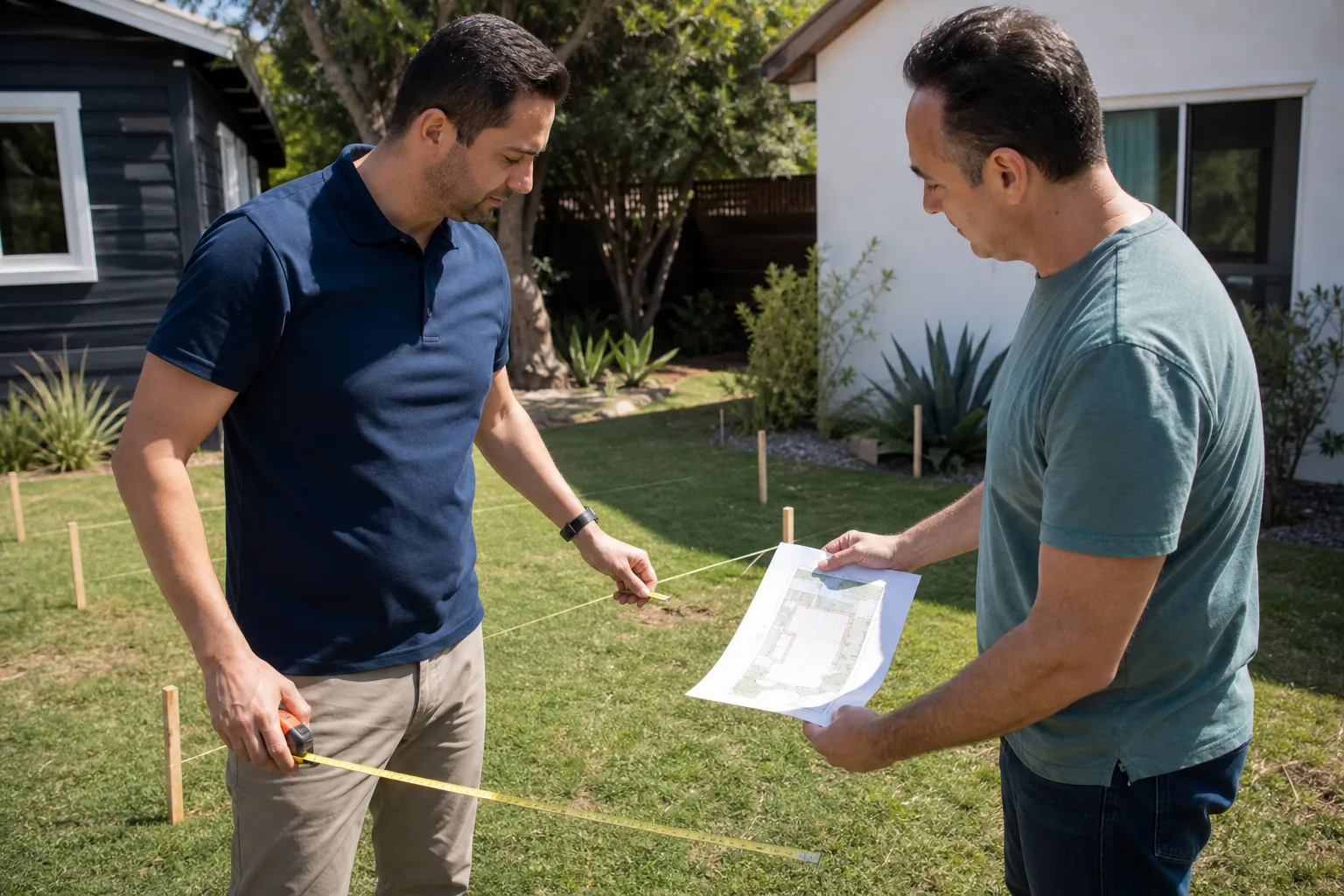
- Site prep and demolition. Tearing out an old shed, clearing landscaping from the footprint, removing fence panels, hauling debris. Heavy work, but no permit required for removal on a residential lot, and no code consequence if you do it wrong.
- Interior painting. Walls, ceilings, trim. Zero code impact. A full interior paint job on a 600-square-foot ADU typically runs $2,500-$4,500 from a pro, and the material cost for a homeowner is a few hundred dollars.
- Landscaping and planting. Grading around the finished structure (below the finished floor line, as directed by your builder), sod, gravel, plants, and paving. This is where careful homeowners save real money.
- Finish carpentry that isn’t inspected. Closet shelving, floating shelves, interior trim work outside of fire-rated assemblies. If it isn’t in the inspection scope and isn’t structural, you can own it.
- Interior decorative finishes. Tile backsplash, wallpaper, cabinet hardware, light fixture swaps after final inspection if the fixture is listed and the box is accessible. Confirm with your electrician before touching a wire.
- Fencing and gates. Though note that fence height and setback rules still apply – see Boulder City’s municipal code for property-line limits.
What ties all six together: none of them touch a permitted trade, none of them change the structure’s life-safety systems, and none of them require a licensed sign-off to pass a county inspection. That’s the DIY zone. Everything else lives on the other side of the line.
One more caveat. Even for legal DIY scope, some builders won’t allow owner labor on a project they’re carrying the permit for, because their warranty and their insurance are on the hook for whatever happens. We’ll cover that conversation in a later section.
How Unpermitted DIY Work Affects Renting and Selling Your ADU
This is the section every DIY guide skips. The financial risk of unpermitted ADU work isn’t a warning that sounds scary – it’s a specific number you can calculate before you decide.
Start with the rental problem. In Boulder City, a detached ADU can only be rented legally once it has a certificate of occupancy as a dwelling unit. If your electrical rough-in failed inspection because the conduit was installed by a homeowner, the county will not issue that certificate. That means no rental income, but the same carrying costs – property tax assessment on the improvement, insurance, utilities, and, if the project was financed, the loan payment. On a $250,000 detached ADU financed at typical 2026 rates, carrying costs run roughly $1,600-$1,900 a month. A project that sits for four months of correction pays $6,400-$7,600 in carrying costs that would never have existed on a permitted build.
Now add correction cost. To pass final inspection, a licensed electrician has to redo the wiring – typically $2,000-$6,000 for an unpermitted ADU rewire depending on how much has to be opened up. If the plumbing was also unpermitted, add another $2,500-$8,000. If the framing has to be exposed to verify structural connections, add finishes on top. It’s not unusual for correction work to cost more than the original DIY scope would have cost to begin properly.
The selling problem is worse because it’s on a timeline. Nevada requires sellers to disclose known construction defects and unpermitted work on the Seller’s Real Property Disclosure Statement. A buyer’s lender and appraiser will pull permit history. An unpermitted ADU that hasn’t been brought into compliance either kills the deal or comes off the price – often by more than the correction would have cost, because the buyer is pricing in the risk and the hassle. In our experience, unpermitted ADU corrections in Boulder City routinely land in the $15,000-$40,000 range by the time every trade is verified and re-inspected.
That’s the whole math. DIY saves money on the front end only if the work you did yourself was legal. On the permitted trades, the “savings” is really a deferral, and the correction bill has carrying costs stacked on top of it.
The True Cost Comparison: Licensed Builder vs. Hybrid vs. Full DIY
To make this concrete, here’s how the numbers shake out on a 600-square-foot detached ADU in Boulder City in 2026. These are planning ranges, not quotes – every lot is different, every product line is different, and site work swings widely depending on slope, utilities, and access.
Fully licensed ADU builder, turnkey:
- Structure, site work, utilities, permits, and finishes: $180,000-$320,000 for a 600-square-foot detached ADU, depending on the product line and site conditions. Prefab brands like Dvele, Plant Prefab, and Mighty Buildings sit in specific bands within that range; site-built custom runs higher.
- Permits and inspections: typically 3-6 percent of project cost, handled by the builder and included in the written price.
- Cosmetic finishing and landscaping: included or added at line-item cost – usually $8,000-$20,000.
- Realistic outcome: unit rented within 30-60 days of final inspection. No correction risk.
Hybrid: licensed builder for permitted scope, owner labor for cosmetics and landscaping:
- Structure, site work, utilities, permits, and rough finishes: $160,000-$290,000, because the builder isn’t carrying painter, landscape, or finish-carpentry labor.
- Owner labor on paint, landscaping, shelving, and cleanup: $4,000-$9,000 in materials plus real homeowner time – typically 80-150 hours across the project.
- Net savings vs. turnkey: typically $8,000-$18,000 when the owner finishes on schedule.
- Realistic outcome: same inspection timeline, same rental date, smaller invoice. This is the sweet spot for hands-on homeowners.
Fully DIY, including permitted trades:
- Materials and self-performed labor for the shell and systems: $110,000-$190,000 if nothing goes wrong – but the numbers assume the owner has genuine trade skill and pulls permits in their own name, which Boulder City limits to owner-occupant single-family projects and still requires trade licensed sign-off on electrical, plumbing, HVAC, and gas.
- Realistic failure rate on permitted-scope DIY: high. Most homeowner-performed electrical and plumbing jobs in an ADU require at least one correction cycle. Correction cost: $5,000-$15,000 on average. Carrying costs during correction: $3,000-$8,000.
- Realistic outcome: project lands 2-6 months behind a builder-scheduled project, and total cost including corrections often meets or exceeds the hybrid number.
The math isn’t always pro-builder – it’s pro-permitted. The hybrid approach wins on cost. The turnkey approach wins on time. The full-DIY approach wins on the spreadsheet only if every correction goes against the plan, which in our experience they don’t.
How to Have an Honest Conversation With an ADU Builder About DIY
Some builders welcome owner labor on cosmetic scope. Others won’t touch it. Getting a straight answer before you sign is the whole game. Here’s how to have the conversation successfully.
- Ask the question in writing, in the scope document. “Can the homeowner perform interior painting, landscaping, and finish carpentry on the project you are permitting?” If the answer is verbal, it doesn’t exist. Get it on paper as a line-item exclusion.
- Ask about the warranty implications. If your painter does a bad job and your drywall expands because of trapped moisture, whose problem is it? Most builders will carve out owner-performed scope from their warranty but keep the rest intact. Make sure the carve-out is specific. At Sutton, our 365-Day Done Right Promise covers defects in workmanship for one full calendar year from project completion – on the work we perform. Owner-performed scope is handled separately and honestly labeled.
- Ask about the schedule dependency. If your landscaping is a phase-completion dependency for the final inspection on a grading element, your schedule is now the project’s schedule. Confirm which owner tasks sit on the critical path and which sit beside it.
- Ask what happens if you don’t finish. Most builders will happily take over the work you abandoned – at their rate, with a change order. Get the change-order rate in writing before you start.
- Ask for the trade licensed sign-off guarantees. Your electrician of record needs to sign off on the electrical package. That signature has to come from a licensed electrician on their permit.
What most builders won’t accept: owner labor on any permitted trade, owner labor on any life-safety system, owner labor on anything tied to a structural inspection, or owner labor that conflicts with their insurance carrier’s requirements. That last category is broader than homeowners expect – many builders’ liability policies require all on-site labor to be performed by their insured subcontractors. When a builder says “we don’t allow owner labor,” that’s usually why.
If you’re comparing builders, our Home Addition Contractor in Boulder City page covers the questions worth asking before a free estimate, and it maps cleanly onto an ADU project.
Boulder City Specifics That Change the DIY Math
Boulder City isn’t the rest of Clark County, and a few local realities change the hybrid-vs-turnkey comparison in ways that matter.
First, the heat. Boulder City regularly breaks 105°F from June through September, and an owner-paint job that stretches across three weekends in July is going to flash-dry and lap in ways a controlled indoor schedule avoids. That’s a $400 mistake, not a $4,000 one, but it’s a real correction. Our Room Addition Contractor in Boulder City team schedules paint coats around these windows for exactly this reason.
Second, the wind. Spring wind in the Mojave whips through exposed sites in Boulder City, which makes any exterior finish work – stucco patch, paint on James Hardie panels, heaving landscape fabric – something to schedule around, not fight through. If your DIY landscaping scope involves grading against a new foundation wall, get the numbers from your builder before you start. Getting the soil line wrong against a stem wall is one of the few “cosmetic” tasks that turns structural.
Third, the historic district. If your lot is inside Boulder City’s historic district boundary, exterior changes – paint colors, fencing, window profiles, even landscape walls over a certain height – require Historic Preservation Commission review. That applies whether a licensed contractor or a homeowner is doing the work. If you’re doing DIY exterior finishes and your property is in the district, call the Boulder City Community Development department before you buy materials.
Fourth, the rental market. Boulder City ADUs rent well because the town is small, the housing stock is old, and proximity to the national recreation area keeps tourism and long-term rental demand steady. A unit that rents for $1,500-$2,200 a month depending on size has carrying costs that bite faster when it sits empty. That raises the cost of DIY failure more than it would in a market with slower rental demand.
Fifth, the product lines. Most Boulder City ADU projects use either prefab from brands like Dvele, Plant Prefab, or Boxabl, or a site-built or garage-conversion approach. Prefab timelines run tighter and leave less room for owner labor in the middle of a delivery window. Site-built leaves more room for a hybrid schedule. The product line you pick quietly determines how much DIY is practical.
When you’re ready to compare what a permitted build actually costs on your lot, our ADU Builders in Boulder City page walks through realistic ranges, and you can always get the direct answer to a same-day question by calling – a live person answers at every hour.
Common Mistakes to Avoid
- Pulling a permit in your own name and then hiring trades yourself. This sounds responsible and is actually the most common way ADU projects fail inspection in Boulder City – your owner-builder permit requires licensed trade sign-off on each trade, and general contractors are reluctant to sign off on work they didn’t supervise. Let the licensed builder carry the permit.
- Assuming that because a task is “cosmetic,” the code doesn’t care. Every fire-rated wall, egress window, and smoke alarm interconnect gets inspected. Painting over a rated assembly is fine. Removing the drywall between the ADU and the main house to “open it up” is a hard fail.
- Doing electrical yourself and expecting it to be insurable. Your homeowner’s policy typically excludes coverage for unpermitted electrical work if a fire is traced to it. Even if the county never catches it, the carrier will when the adjuster arrives.
- Buying materials before scope is locked. Homeowners who buy fixtures, tile, and paint before the builder’s scope is written end up eating returned-material costs when the products don’t match the drawn plans. Prefab product lines like Mighty Buildings and Dvele come with their own specification sheets – don’t cross-shop finishes before you’ve read them.
- Underestimating homeowner labor hours. A full interior paint job plus landscaping plus touch-up carpentry on a 600-square-foot ADU is 80-150 hours. If you bill your own time at anything, the savings shrink fast.
- Letting the DIY scope sit on the critical path. If your landscaping finish is a grading inspection dependency, every weekend you skip pushes the whole project’s final inspection and every dollar of carrying cost with it.
- Hiding DIY work from your builder. Even if the work is passed and inspected, undisclosed owner changes to permitted scope can void the builder’s workmanship warranty on adjacent items. Disclose everything, in writing.
When to Call a Professional
If your ADU project involves any electrical, plumbing, HVAC, gas, structural, or life-safety scope – and every ADU does – you need a licensed professional carrying the permit. Call a professional the moment any of the following is true: your project needs a permit pulled (an ADU always does); your lot is in Boulder City’s historic district and you’re changing anything on the exterior; you’re planning a garage conversion and the existing structure has to be evaluated for code compliance; you’re considering prefab and the delivery and set timelines matter to your budget; or you simply don’t have the trade skill to perform the permitted work correctly. Sutton ADU Builders Boulder City offers free estimates in Boulder City – call (888) 296-0055. We’ll give you a written price before any work begins, tell you exactly which technicians will be on your property with their name and photo in advance, and stand behind the work with our 365-Day Done Right Promise. Every Sutton location is independently owned and operated under the Threshold Verified standards.
Frequently Asked Questions
Yes – landscaping, interior painting, finish carpentry that isn’t inspection-scoped, site prep and demolition, and fencing (subject to height and setback limits) are all legal for a homeowner to perform on an ADU project in Boulder City. Electrical, plumbing, HVAC, gas, and structural work require a licensed contractor and a permit. Call (888) 296-0055 for a free estimate that breaks out which scope you can own and which scope stays with the licensed trades.
The project stops. The Boulder City building department will not issue a certificate of occupancy until the electrical package passes, and correction requires a licensed electrician to redo the work and re-inspect. In our experience, correction costs on unpermitted ADU electrical typically run $2,000-$6,000 before you add the carrying costs on a unit that can’t be rented during the correction. Call (888) 296-0055 if you’re weighing whether to try the work yourself – the answer is almost always no.
A hybrid approach on a 600-square-foot detached ADU in Boulder City typically lands in the $160,000-$290,000 range for the permitted build, plus $4,000-$9,000 in materials for the homeowner-performed cosmetics and landscaping. That usually saves $8,000-$18,000 compared to a fully turnkey build. Call (888) 296-0055 for a free written estimate on your specific lot – estimates are free and the price you receive in writing is the price.
Yes. Nevada’s Seller’s Real Property Disclosure Statement requires disclosure of unpermitted work and known defects, and buyers’ lenders and appraisers pull permit history. An unpermitted ADU either kills the sale or comes off the price by more than correction would cost, and correction on a full ADU scope typically runs $15,000-$40,000. Call (888) 296-0055 before you take on any work that would show up on a permit history.
Some will, some won’t. Builders that do typically allow owner labor on painting, landscaping, and finish carpentry, and won’t allow it on any permitted trade or life-safety scope. The carve-out needs to be written into the scope document, not just verbally agreed. Call (888) 296-0055 and we’ll tell you upfront which scope your project can reasonably hand to you and which scope it can’t.
Yes. Prefab ADUs from brands like Dvele, Plant Prefab, or Boxabl still require site work, foundations, utility tie-ins, and final inspections performed under a licensed contractor’s permit – the prefab shell is only part of the project. In our experience, roughly 35-50 percent of a prefab ADU’s total cost sits in site work and hookups, not the unit itself. Call (888) 296-0055 for a free estimate that separates the unit cost from the site cost.
The Bottom Line
DIY on an ADU isn’t all-or-nothing. The permitted trades – electrical, plumbing, HVAC, gas, structural – aren’t DIY categories in Nevada, and treating them as such turns a savings plan into a correction bill with carrying costs stacked on top. The work that is legal, insurable, and worth doing yourself is a real 10-20 percent of the budget: painting, landscaping, site prep, finish carpentry. The people who get the best outcome in Boulder City are the ones who hire a licensed builder for the permitted scope, take on the cosmetics themselves, get the boundary in writing, and never touch a wire. Start with Sutton ADU Builders Boulder City home or call (888) 296-0055 for a free estimate – a written price before any work begins, and a live person on the phone at any hour.
Written by the team at Sutton ADU Builders Boulder City.